Designing an intelligent organizational assistant for "Arca"; From information search to intelligent interaction
Brand Type: B2B engineering and consulting services company
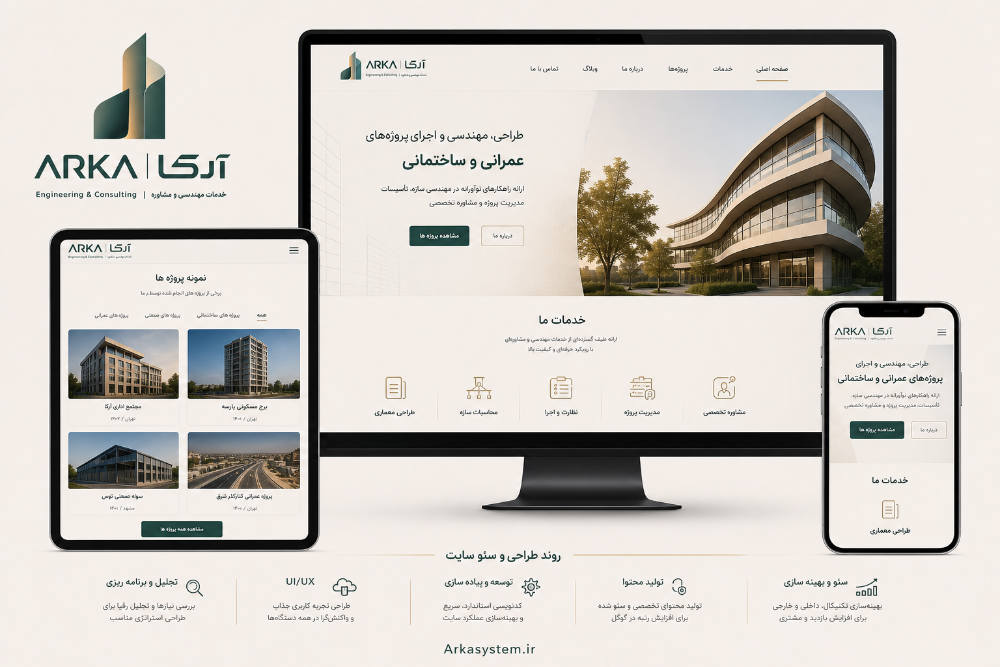
Brand name: ARKA
Netanik services: AI Strategy, RAG, AI Agent, Knowledge Base and Automation
Infrastructure and site technical manager: Navid Zamani
Project manager and graphic designer: Sohail Motaghinia
Enterprise intelligent assistant for Arca
"Arka" company is a B2B engineering and consulting services group that had a considerable amount of information, documents, contracts, catalogs, reports and specialized knowledge during its years of operation. The main problem here was not the lack of information; The problem was that finding the right information at the right time was not always easy, and a significant part of the experts' time was spent searching through files and sources. Netanik for this series Enterprise intelligent assistant designed to transform the organization's scattered knowledge into a searchable and interactive environment. The goal of the project was not to build a simple chatbot, but to create an intelligent layer for faster and more structured access to organizational knowledge.
The main problem of Arca
In organizations where the volume of information increases at a high speed, storing files alone does not mean the availability of knowledge. Arca information was stored in different formats and in different departments, and experts sometimes had to check several documents manually to find the desired answer. In addition to being time-consuming, this process was highly dependent on people's experience and knowledge of the information storage location. Therefore, the required solution should be able to understand the concept of the question and instead of displaying a set of files, it should extract relevant information from the available sources.
The purpose of the design Smart assistant
Netanik's goal was to create a system where employees can interact with the organization's knowledge using natural language. The user should not have to know the exact file name, folder path, or keyword used in the document to get the answer. The system should be able to analyze the question, find the relevant resources and provide the answer based on the valid information of the organization. At the same time, the architecture had to be designed to allow for resource control, knowledge updating, and human supervision.
Enterprise intelligent assistant architecture
In designing this Enterprise intelligent assistant, Netanik used a RAG-based architecture so that the AI model could retrieve relevant information from Arca's proprietary knowledge base before generating an answer. This approach makes the answers not generated solely based on the general knowledge of the language model and the system can use the specific information of the organization. After receiving, the documents were processed and prepared, and their searchable content was placed in the appropriate structure. Then, when the user asks, the system first finds the relevant resources and provides the retrieved information to the model.
Information receiving and processing layer
The first part of the system was related to data entry and had the task of preparing various sources for use in the knowledge base. Text files, PDFs, internal documentation, and other usable resources should be structured and prepared for semantic search upon receipt. At this stage, data quality was very important, because an intelligent system cannot produce reliable output from incomplete or messy data. For this reason, the project architecture also considered the process of entering and preparing information as a part of the system.
Knowledge and retrieval layer
After processing the information, the content of the documents was put into a retrievable structure so that the system could find relevant sections based on the concept of the question. This step is the main difference between a general chatbot and a Enterprise intelligent assistant shows In this architecture, the answer is first connected to the information in the organization's knowledge base, and then the language model takes over the task of understanding, combining and presenting the answer. Such a structure allows more control over information sources and updating knowledge.
How was RAG used in the Arca project?
RAG or Retrieval-Augmented Generation was one of the main components of the architecture of this project and its role was defined as connecting the language model to the specific knowledge of the organization. Instead of storing all the organization's information in the model itself, the information was stored in an external knowledge base and the system retrieved the relevant parts when it received a query. This information was then fed to the model to produce a final response based on the actual content of the documents. This architecture enables the creation of a dynamic system that updates its usable knowledge as new documents are added.
Smart response cycle
The response process of the system was designed in several specific steps so that each request has a specific path. First, the user's question is analyzed and then the system finds relevant parts of the knowledge base according to its meaning. The retrieved information is provided to the model and the model produces an understandable and structured response based on the same context. Finally, the response is displayed to the user and the source information can also be provided if needed.
Controlling response sources
One of the important considerations of the project was the ability to check the source of information, and for this reason, the architecture was designed in such a way that the answers are traceable to organizational sources as much as possible. This feature is especially important for B2B environments, because the user needs to know on what basis the information provided is formed. Displaying or logging the source can simplify the human review process and build more confidence in the system's output. For this reason, in this project, the quality of information retrieval was as important as the quality of response generation.
Smart assistant user experience
Although most of the complexity of the project was behind the system, the user experience was also considered as an important part from the beginning. Arca users were not supposed to work with a complex technical tool and should be able to ask their question like a natural conversation. The user interface was designed with a focus on simplicity so that the user can ask a question, receive an answer, and continue to the next question based on the same topic if needed. This interaction model allows the use of Enterprise intelligent assistant It is possible for different users without the need for extensive technical training.
Natural interaction with organization knowledge
One of the main values of this system was to transform the traditional search experience into a conversational experience. Instead of searching for several keywords and checking different results, the user could explain his problem in natural language. The system tried to recognize the meaning of the request and extract relevant information from the organization's resources. This interaction model reduces the gap between "stored information" and "usable knowledge".
Management of complex questions
Not all inquiries are the same, and some inquiries may require several different sources. In such a situation, the system must be able to retrieve relevant information from multiple parts and combine them into a coherent response. The architecture designed for Arca was developed with this in mind, so that the system is not only used for simple queries. In the future, this capability will allow the development of the assistant towards more specialized processes of the organization.
Security and access management
in one Enterprise intelligent assistant, information security is as important as AI performance. Not all organizational documents are necessarily accessible to all users, and the system architecture must be able to differentiate between different levels of access. For this reason, the issue of access management was taken into consideration in the design of the solution so that in the development path, it is possible to connect the knowledge of the organization to different roles and permissions. The goal was to prevent artificial intelligence from becoming an unwanted path to access sensitive information.
Separation of access levels
The access structure can be defined based on the role, organizational unit or type of information, and each user can access only a part of the knowledge they need. In addition to increasing security, this approach makes the system's responses appropriate to the user's situation. In a large organization, such an architecture can prevent unwanted exposure of internal information. Designing this layer from scratch also simplifies the future development of the system.
Human control and supervision
Artificial intelligence in this project was not defined as a completely independent system and human control remained part of the architecture. Managers can check knowledge sources, information structure and system performance and make necessary changes if needed. This is especially important in corporate environments, as not all responses should be used without review in sensitive processes. Enterprise intelligent assistant It is valuable when it works alongside man, not when it replaces him without control.
Arca system key capabilities
The solution designed for Arca consisted of several main features, each of which covered a part of the organization's needs. The main focus was on creating a flexible system so that new capabilities can be added in the future without completely redesigning the architecture. This approach makes investing in AI not limited to a short-term project and it can be developed gradually. Some of the main features of the system are:
Searching for meaning in organizational documents
Conversational response to users' questions
Connecting answers to a dedicated knowledge base
Managing and updating information sources
Ability to define different levels of access
Ability to expand to other organizational processes
Expandable infrastructure
One of the important decisions of Netanik was to design a modular architecture so that the system can be connected to other tools and services in the future. For example, the ability to connect the assistant to CRM, ticketing system, project management tools or other internal systems can extend its capabilities beyond just answering. In this case, AI can play a role in executing specific processes in addition to information retrieval. This path can transform the basic architecture of Arca into one Enterprise AI Agent to become more complete
Connect to enterprise tools
With the development of the architecture, the assistant can connect to internal systems in the future and receive the required information from various sources. Such a connection requires the precise definition of permissions, APIs, and operation execution rules so that each action can be performed under the control of the system. Netanik's goal from the beginning was that the project structure has the capacity for such an expansion. So Assistant was not designed as a closed product, but as a scalable infrastructure.
The result of the project and the created value
The main value of the Arca project cannot be summed up simply in "answering questions". The more important issue was turning the large amount of scattered information into an interactive and usable experience for employees. This system can reduce information search time, simplify access to organizational knowledge, and reduce users' dependence on knowing file storage paths. Besides these, the designed architecture provides a platform for the development of more intelligent capabilities in the future.
Changing the approach to organizational knowledge
Before such a system, many organizations simply store their knowledge in the form of files and documents and expect users to be able to find it when they need it. The new approach takes knowledge out of the archive and turns it into an interactive layer that users can interact with. This shift can transform the way employees use internal information and create new avenues for automation. For Arca, the main goal was the same: to transform existing information into knowledge that can be used at the moment.
Netanik's role in the project
In this project, Netanik did not just play the role of a chatbot developer, and the issue was investigated from the perspective of strategy, architecture and user experience. From the analysis of the organization's needs and the design of the knowledge structure to the definition of the RAG architecture, the interaction flow and the future development path, the various components of the solution were designed together. This approach made AI technology to be in the heart of the real business need and not become an independent capability and separated from the organization structure. The result was an extensible architecture for Arca's gradual move toward broader use of artificial intelligence.
The future of Arca's smart assistant
An early version of this Enterprise intelligent assistant It can be the starting point of a bigger path and its capabilities will expand to more areas in the future. Connection to CRM, analysis of customer requests, production of management reports, automatic processing of documents and implementation of some organizational operations are among possible development paths. With the addition of these capabilities, the system becomes closer from a question and answer tool to an intelligent agent that can play a role in the implementation of specific processes. The basic modular design makes it possible to add any functionality at the right time and according to the actual needs of the organization.
From Chatbot to AI Agent
The difference between a simple chatbot and an AI agent is in the system's ability to understand the goal, control access to resources, and perform specific actions. Arca's development path can also move from answering information to implementing defined processes. In such a model, the system can receive the request, collect the necessary information, execute certain logic and provide the result to the user. This is the point at which AI can transform from a conversational interface to part of an organization's operational infrastructure.
summary
The Arca project is an example of Netanik's approach to designing artificial intelligence solutions for businesses; An approach where AI is not seen separately from digital strategy and infrastructure. one Enterprise intelligent assistant It can create real value when it is connected to valid data, proper architecture, security, user experience and real processes of the organization. In this project, Netanik attempted to design such an infrastructure with a focus on RAG, proprietary knowledge, and extensibility. The result was a platform that can meet the needs of today's organization and pave the way for more advanced AI agents.