Idea: A memory that should not be extinguished
the idea of1418Days.irIt was born out of this concern: that the memory of that era, with all its sufferings and joys, should always be alive. Not in the form of a set of dates and statistics that are memorized just for an exam, but in the form of an experience that children can relate to, feel and remember.
Each generation that moves further away from a great event feels the danger of forgetting closer. Those who saw the war with their own eyes are leaving us one by one and with them hundreds of untold memories: letters left in homes, photos that no one knows the names of, stories that were only told at family tables.
We wanted today's children and teenagers, who grow up in a world of games and interactive screens, to be able to hear about the small and large realities of that time: from 125 grams of bread, which was the daily portion of a child in Leningrad, to the moment when soldiers of two fronts met in the snow and hugged each other. We wanted to show history as it was: bitter, sweet, and full of courage.
"The war that lasted for 1418 days should not be summed up in a few lines of a textbook."
Why was such a platform necessary?
Most of the resources available to children about the Great Patriotic War are either too dry and academic, or they tend to show violence that is not appropriate for this age. Between the two, there was a huge void: a resource that was both accurate and engaging, honest and child-friendly.
Another problem was dispersion. The events of the war are usually told separately: Stalingrad in one chapter, the Siege of Leningrad in another, and the rear is often completely forgotten. While these events were happening at the same time. In the days when they were fighting for every house in Stalingrad, Shostakovich's 7th symphony was being played in Leningrad, and in the Urals, teenagers were standing on boxes to reach the lathe.
"1418 Days" puts these pieces together. The user moves on a timeline and in each month, he sees a complete picture of the war: the front, behind the front and the world. This holistic view is something that books rarely provide.
Travel experience: a map that breathes
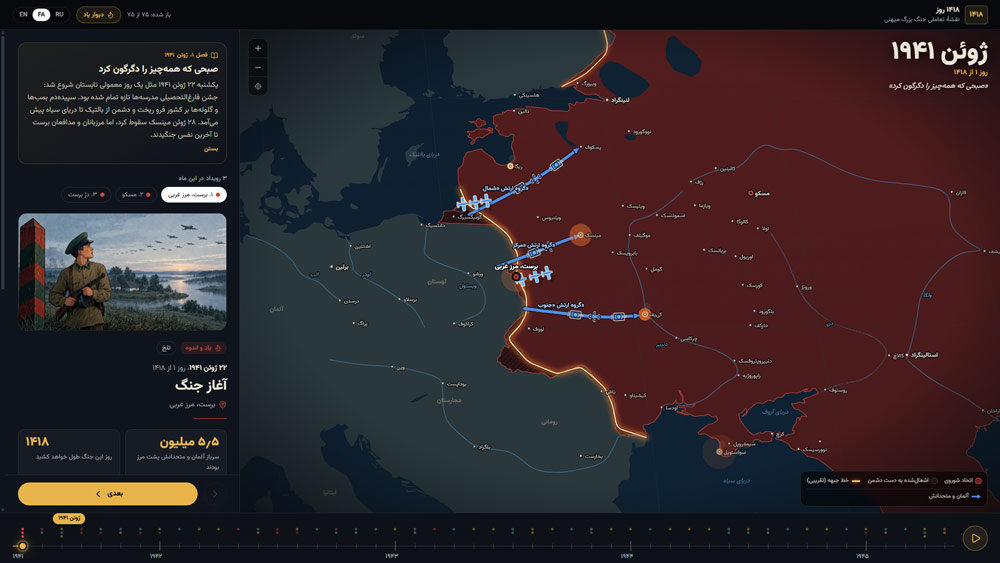
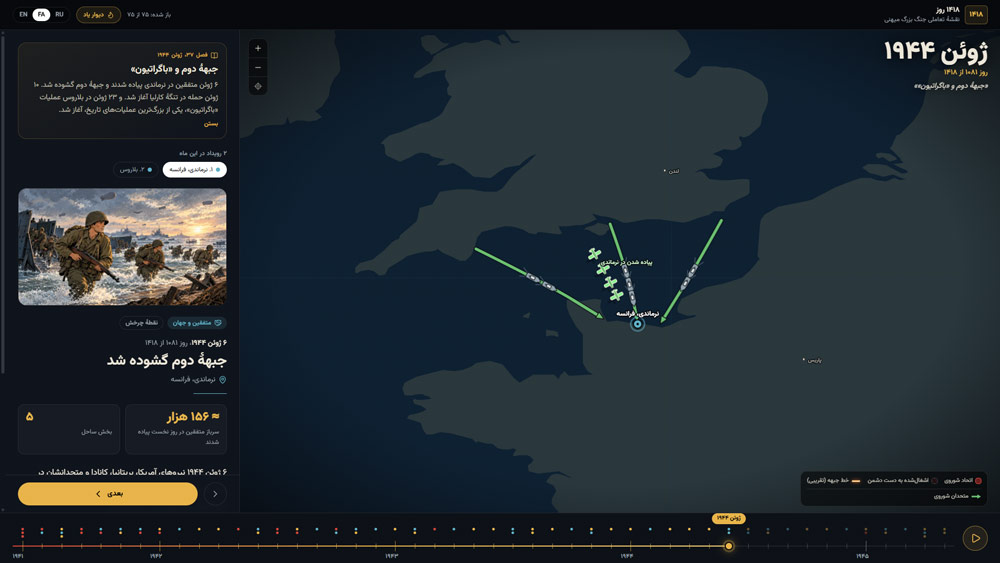
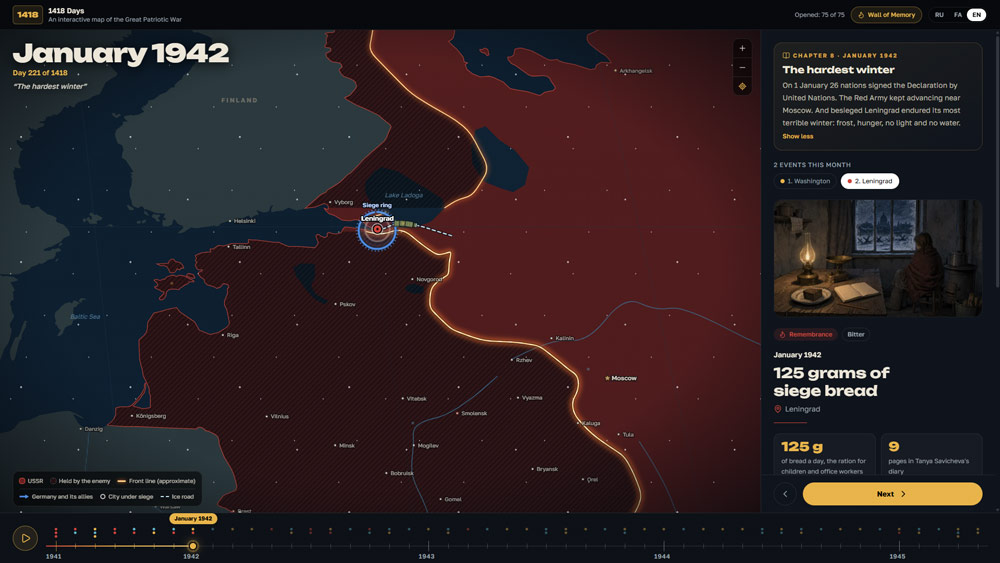
The heart of the platform is an interactive map of the world designed with the actual borders of 1941, not today's borders. This small detail was very important to us, because showing the present borders on the 1941 map was a historical error.
Journey Page: A live map next to the story, with pictures, numbers and a timeline
Several layers work together on this map:
● The front line is moving day by day. From the border of Brest in the early days to the gates of Moscow, the banks of the Volga and finally Berlin. Between key dates, the line moves in a smooth motion so that the user can actually see the advance and retreat.
● Occupied territories are marked with Hashur and become smaller and larger as the front moves. Without needing to explain, the child sees what a large part of the country was under occupation in one period and how it was liberated step by step.
● All 75 events have their own animated scene. The camera flies to the location of the event and then the scene is drawn: attack arrows, siege rings, aid routes such as Pars Corridor and polar convoys, and the road of life on the ice of Lake Ladoga.
● Colors have meaning: red for the Red Army, blue for the enemy, and green for the Allies, as was customary on Soviet military maps. The map guide in each scene only explains what is seen on the screen.
● The user is free: he can zoom, drag the map, zoom in on the mobile with two fingers and return to the event whenever he wants with a button. As you zoom in, rivers, seas, and dozens of other cities appear.
The timeline at the bottom of the page shows the 48 months of the war, and with colored dots, the number and mood of each month's events is introduced before it opens. The autoplay button plays the entire war before the user's eyes like a documentary. Each user's progress is also saved so that the next time they can continue from where they left off.
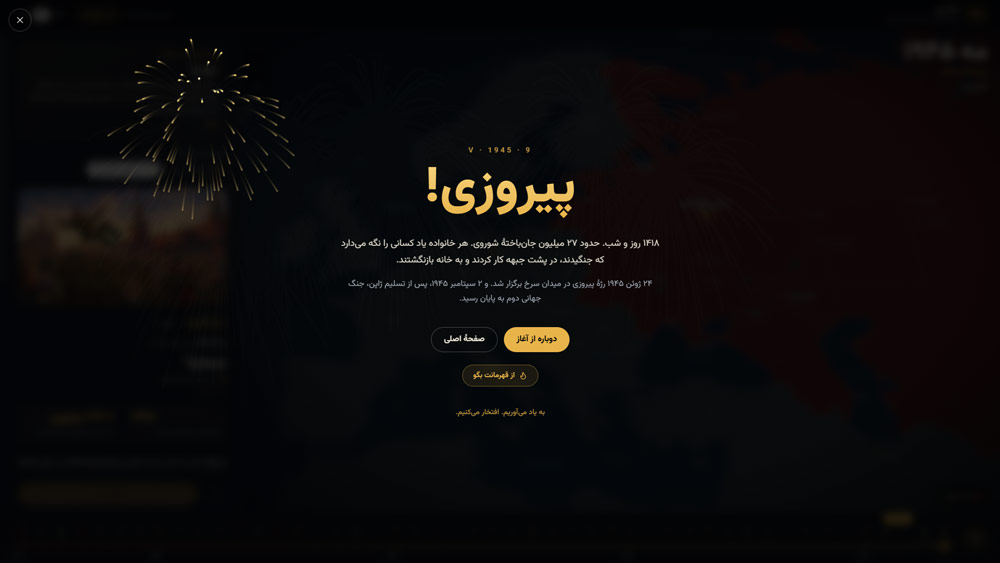
And when the user reaches May 9, 1945, the journey ends with the scene the kids have been waiting for: fireworks of victory, and an invitation to commemorate their family's hero.
75 stories, 48 chapters: a narrative with emotion
In the early versions, the texts were short and general. We soon realized that this was not enough. Generalization does not create feelings; It is the details that are remembered. So we rewrote the content with more depth.
Today, every story has several layers:
● The main paragraph that defines the story in simple and clear language.
● A deeper layer for the curious reader, with human details: a grandfather in Khatin village who was the only survivor of his village, a blacksmith family in Tashkent who adopted fifteen orphaned children of different nationalities, or scientists who starved to death in the siege of Leningrad but did not touch their institute's seed collection.
Number tiles that show one truth at a glance: 872 days of siege, 125 grams of bread, 250 days of defense of Sevastopol.
● Real and documented quotes, such as Tanya Savichova's notebook, Shostakovich's 7th symphony preface or Konstantin Simonov's poem "Wait for me".
● Did you know? For the things that the child likes to tell his friends.
Along with these stories, 48 monthly chapters were written, each of which shows in a few sentences what the war was like on all the fronts, behind the front and in the world in that month. In this way, each story is placed in its proper context.
The color of each story also shows its mood: red for bitter moments, gold for sweet moments and blue for turning points. The history of this war was not only suffering; It was also full of moments of joy, hope and solidarity, and we wanted the kids to see both sides of that.
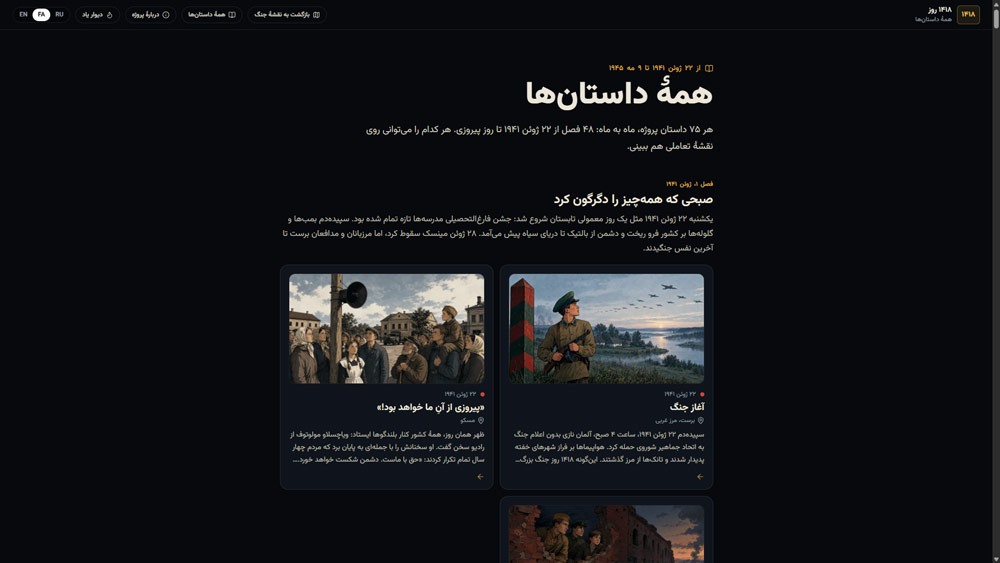
Pictures: Every story, a lasting scene
For children and teenagers, the image is more powerful than any text. For this reason, a dedicated illustration was created for each of the 75 stories, with a uniform style similar to graphic novels: ink lines, limited colors of navy, brick red and gold, and warm and dignified faces.
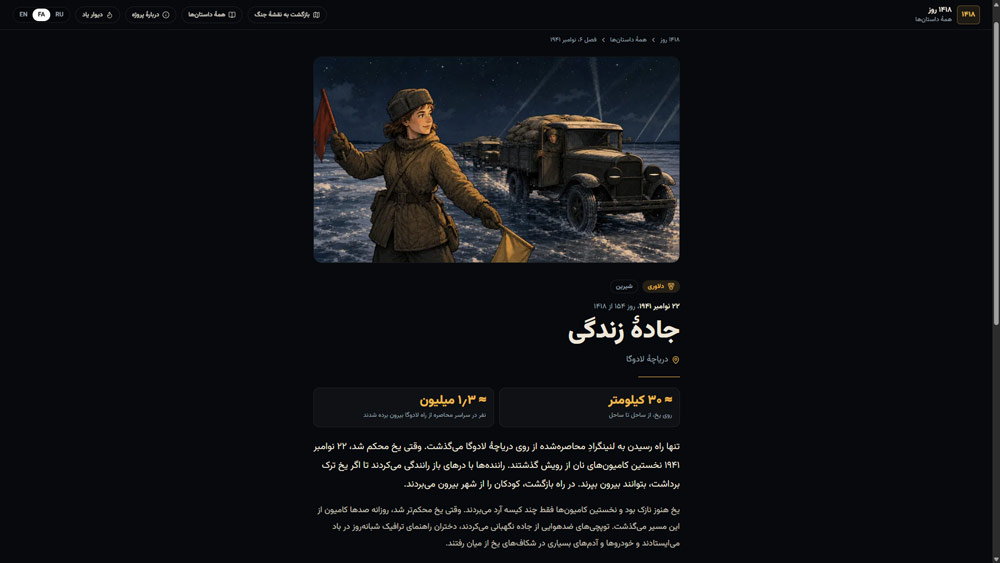
The road of life: convoy of trucks on the ice of Lake Ladoga, winter 1941
But what distinguishes these images is their historical accuracy. Each image was individually reviewed before publication and dozens of details were controlled:
● Uniforms by date of each event: kerchiefs became common in the Red Army only from 1943, so no soldier in the 1941 and 1942 images has a kerchief.
● Equipment of each period: Tanks of 1941 are early model with short barrel and later models are only seen in pictures of the last years of the war.
● Blackout at night: During the nights of the war, the lights of the cars were turned off and there were no open windows. The night images show the same.
● Real people and places: At the Tehran conference, Churchill is seen in the blue uniform of the air force, as he was in reality; And the flag of victory is raised on the roof of the Reichstag itself, next to the equestrian statue and its burnt dome.
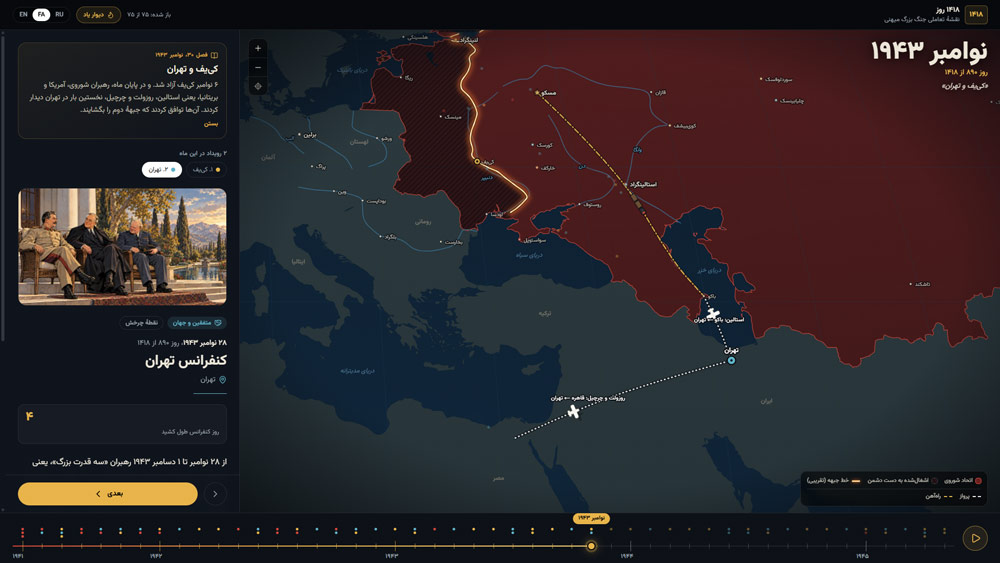
Tehran Conference, November 1943
In tragic stories, such as Khatin or Auschwitz, our approach was symbolic. No images show violence or physical suffering. Instead, the lonely chimneys of a burned-out village with their bells, or a soldier throwing his coat over a child's shoulder, convey the same sentiment with reverence. There are no Nazi symbols in any of the images.
These images are displayed in the map panel, on each story page, in the story list, and in share cards. When someone sends a link to a story in Telegram or social networks, the same image will be displayed with the title of the story in his own language.
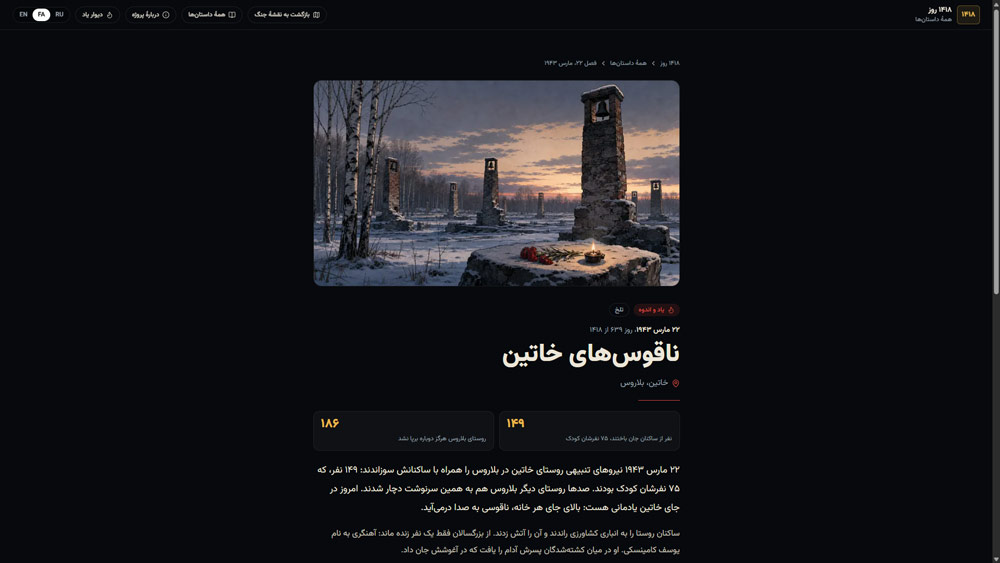
March 22, 1943, day 639 of 1418 Women's bells
Memory wall: Every family, a hero
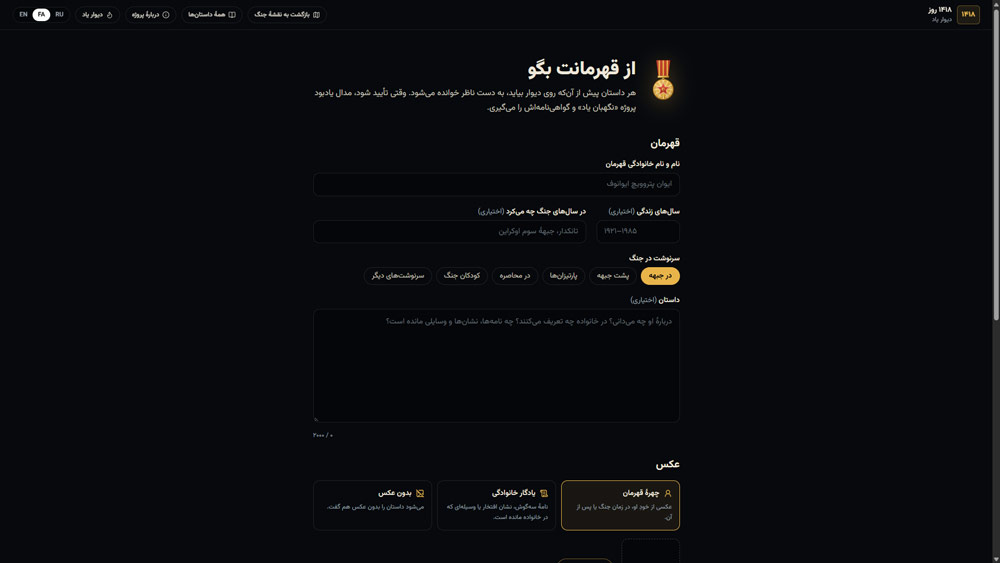
History is not only in books; It is also in homes. Almost every family in Russia has someone who fought at the front, worked behind the front, or lived through the siege and occupation. The Wall of Memory is where these memories come together, inspired by the beautiful tradition of the Eternal Regiment.
A child or teenager can record the name of their great-grandparent, write what they did during the war years, write a story told in the family, and add a photo of them or a family memento such as a trident letter or badge of honor.
Since the audience of this section is children, teenagers and young people, safety and respect were the first priority in its design:
● No stories will be published before review by a moderator.
● Only first name and age are asked from the sender; No last name, no school, no address.
● Photos are resized in the same browser and their hidden information, such as location, is erased.
● Photos remain private until verified and only the sender and moderator can see them.
When a story is approved, the submitter will receive a commemorative medallion of the project named "Keeper of Memory", along with a beautiful certificate in their own language that they can download, print and keep at home. This medal gives the child a sense of pride that he also has a role in keeping the memory alive. In fact, the memorial wall is a bridge between the big history and the small history of each family.
Three languages, one common memory
"1418 Days" was designed from the beginning in three languages: Russian, Farsi and English. The Farsi version is completely right-to-left, with legible Persian numbers and punctuation. Each language has its own pages and is not just a machine translation of another language.
This choice has a deeper meaning. The Great Patriotic War is not just the history of a country. Stories like "Dalan Pars", a path that stretched from the ports of southern Iran to the north and a large part of the aid of the allies passed through it, or the Tehran conference where the leaders of the three great powers met for the first time, show that this memory is shared among nations. The workers, drivers and employees of the Iranian Railways also contributed to this victory, and this platform keeps their memory alive.
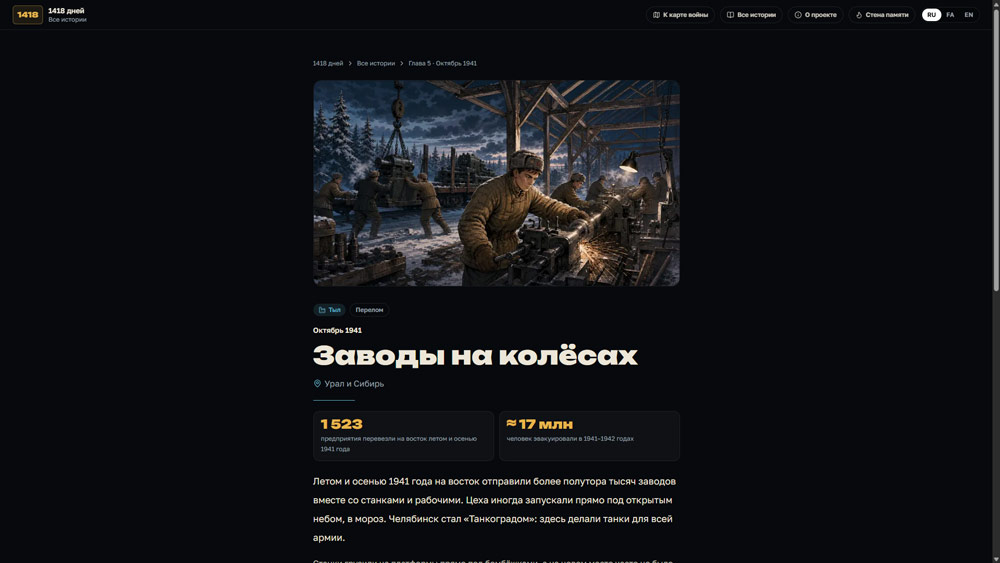
"All stories" page: 48 chapters and 75 stories with pictures
Behind the Scenes: Made to Stay
A platform that is supposed to keep alive the memory of an era must be durable, fast and reliable. The technical architecture of the project was designed in this way:
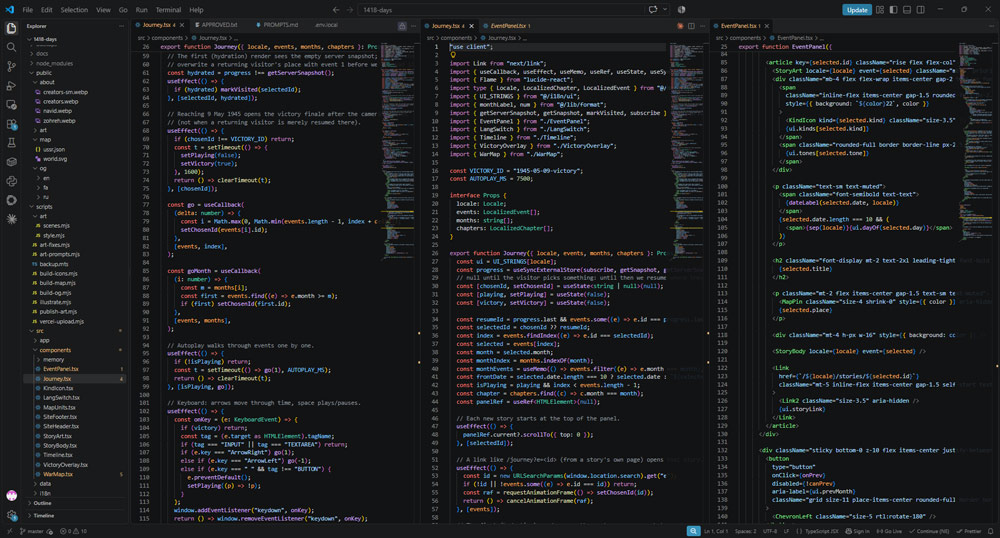
● Next.js and React for the user interface, with pages that are pre-built to load in less than a second, even on weak internet.
● The map is drawn with d3-geo and SVG; Without any external map service, light and independent. All animations are synchronized with the movement of the camera and are automatically relaxed for users who prefer less movement.
● Supabase For safe storage of memory wall stories and photos, with fully controlled access from the server side.
● Vercel For fast worldwide hosting.
● Images are presented in two sizes and in compressed WebP format to load quickly on mobile phones.
Security was also taken seriously: Content Security Policy (CSP), mandatory encryption of communication, restriction of attempts to login to the moderator panel and constant checking of dependencies. The site works equally well on mobile, tablet and desktop.
Visibility: When the date is found
A good source is only effective when found. For this reason, each story has its own independent page in all three languages, that is, 225 full pages that search engines can recognize. Each page has structured data that tells the searcher what event this story is about, on what date and where it happened on the map.
The platform is also ready for the new generation of search. AI assistants that many children and teachers ask their questions to today read the full text of chapters and stories through special files and can refer to this resource. That way, when a student asks a question about The Road of Life or the Battle of Kursk, these stories can be part of the answer.
Accuracy and respect, above all
In a project that deals with the memory of millions of families, any mistake is disrespectful. For this reason, we followed several principles from beginning to end:
● Only documented facts, and avoiding common myths and exaggerated narratives.
● Honesty in narration: both victories and defeats, bravery and sadness are told.
● Child-friendly tone, no harsh details, but no stealth.
● Respect to all nations who suffered and fought in this war.
● Absence of any Nazi symbols on the entire platform.
This precision even reached details that may not be visible at first glance: from the correct way of writing in Persian text for years until the separator "·" in Farsi was replaced with a Farsi comma, because its shape is similar to the Persian zero and it made reading confusing.
A journey, from a child's point of view
Artyom is twelve years old. Site 1418Days.ir opens and clicks on "Start the journey". It is the morning of June 22, 1941; A young border guard is standing next to the border post and looking at the planes that are flying in the sky. The front line on the map begins to move. Artyom moves forward a few months and reaches Leningrad; The siege ring is stretched around the city and he read for the first time that a child his age had only 125 grams of bread a day.
A little later, the convoy sees trucks on the ice of Ladoga, driving with the doors open. In Stalingrad, he finds Pavlov's house and in Tehran, he is surprised to see three great world leaders sitting together in a city far from the front. When it arrives on May 9, 1945, victory fireworks light up the sky. That night he asks his grandmother what his great grandfather did in the war, and tomorrow he records his story on the wall of memory.
This is exactly what we wanted: that the date starts on the screen and ends up being a conversation at home.
the result
«1418Days.ir» is a complete and live platform:
● 75 stories and 48 chapters, in Persian, Russian and English languages.
● 75 exclusive images, each historically reviewed.
● A live map with an animated scene for each event.
● Memorial wall, to record the memories of families, along with medals and certificates.
● 225 pages of story, ready for Search engines and Artificial intelligence assistants.
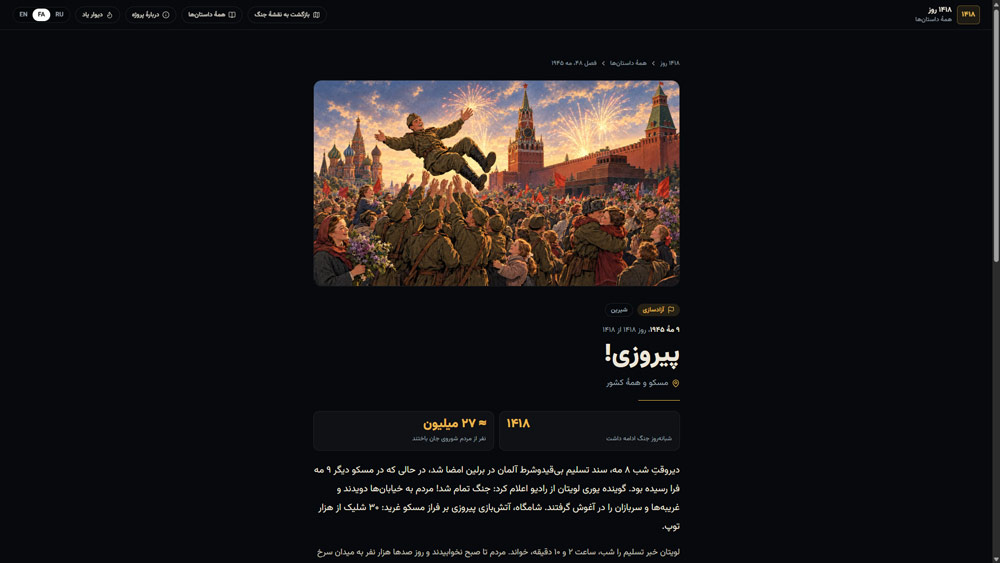
This platform is a ready-made tool for the history teacher that he can display on the screen in the classrooms. It is a way for parents to talk to their children about family history. And for the children themselves, it is a journey that may be the first time they feel that history is not just about the past, it is about people who were like them: the children who stood on boxes to work, the girls who flew at night and the soldiers who hugged each other in the snow.
We believe that the memory of those 1418 days should not remain in museums and archives. It should be alive, accessible and spoken in a language that today's generation can hear. "1418Days.ir" is an attempt for this: So that no one and nothing is forgotten.