Evidence-based news verification web platform powered by artificial intelligence
Every day we receive dozens of messages, headlines and "breaking news" that we do not know where they came from. Many people turn to AI chatbots to measure this, but chatbots usually answer with complete confidence, even when they have no witnesses; And sometimes they cite a source or link that doesn't exist at all. That is, the tool that was supposed to prevent false information can itself become a new source of false information.
Honest Lens Here's our answer to this problem: a platform that breaks down each news piece into separate, quantifiable claims, weighs each claim against the evidence, actually opens and checks every link it cites, and if there isn't enough evidence, says "not enough evidence" instead of just guessing honestly. The platform has even measured its own accuracy publicly and published all the results, including the ones it got wrong.
Problem: Why was such a tool necessary?
1. Flood of information and forward messages
A large part of the news today reaches people not from news agencies, but from messaging groups and channels: a message that is quoted "from a reliable source", a number that is separated from its context, or a headline that is far from the main news text. Most people have neither the time nor the tools to root for each.
2. Chatbots are not built for verification
Public chatbots are amazing tools, but they have a few inherent weaknesses when it comes to verification. They give a blanket answer for the entire text, rarely indicate which sources they've actually checked, the links they make may be broken or bogus, and most importantly, they rarely say "I don't know". None of them tell you how accurate they are at verification.
3. Tool space for Persian and Russian speakers
Most serious verification tools are designed for an English-speaking audience. A Persian- or Russian-speaking user either has to work with a tool in a language other than his own, or has no tool at all. Persian interfaces have often half-implemented right-to-left; The texts get messed up, the numbers are shifted and the user experience becomes annoying.
4. Crisis of trust
People don't trust a tool that just says "right" or "wrong," and rightly so. Trust is built when you can see for yourself what the verdict is based on, and when the tool doesn't hide its limitations. Our goal was to build such a tool.
Idea: The Philosophy of "I Don't Know"
The starting point of the project was a sentence that later became the slogan and compass of all decisions:
"The verification that does not issue a final verdict, but shows the evidence; And when he doesn't have enough data, he honestly says: I don't know."
This sentence in practice determined several important decisions of the product. First, instead of a zero-to-hundred score or percentage of "truth" that looks scientific but doesn't actually explain anything, each claim gets one of four clear conclusions, along with a reason and source. Second, "insufficient evidence" is a complete and honorable conclusion, not a failure of the system. And thirdly, the tool should be as honest about itself as about the news; It means to measure its accuracy and publish it.
the result | meaning |
Confirmed | The evidence supports the claim. |
rejected | The evidence shows the opposite of the claim. |
misleading | Part of it is true, but it's phrased or out of context in a way that gives the wrong impression. |
Insufficient evidence | There is still insufficient public evidence. Instead of guessing, we'll say the same. |
Solution: three columns
Honest Lens is built on three pillars, each of which answers a part of the problem.
Column A: Engine claims and evidence
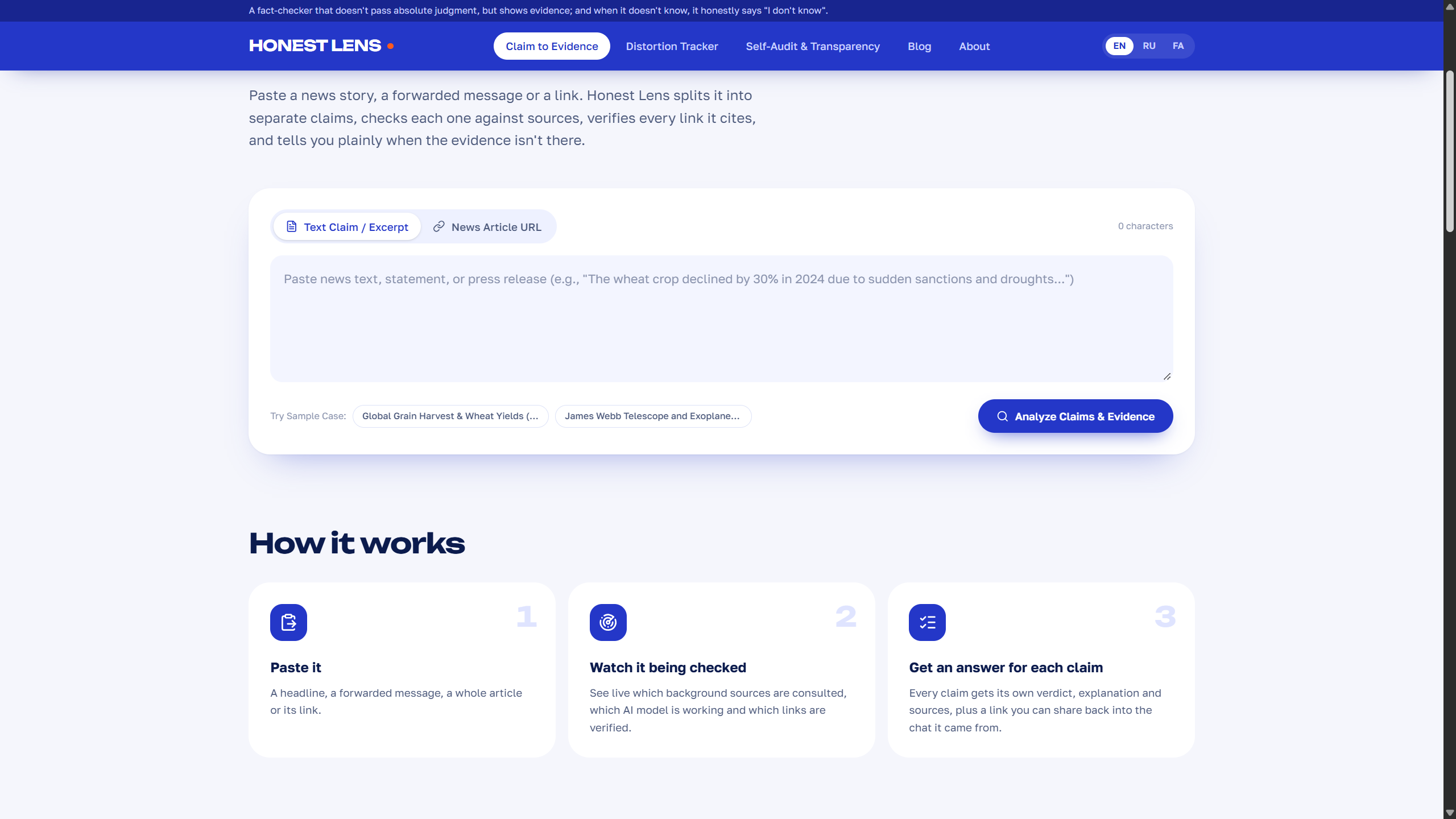
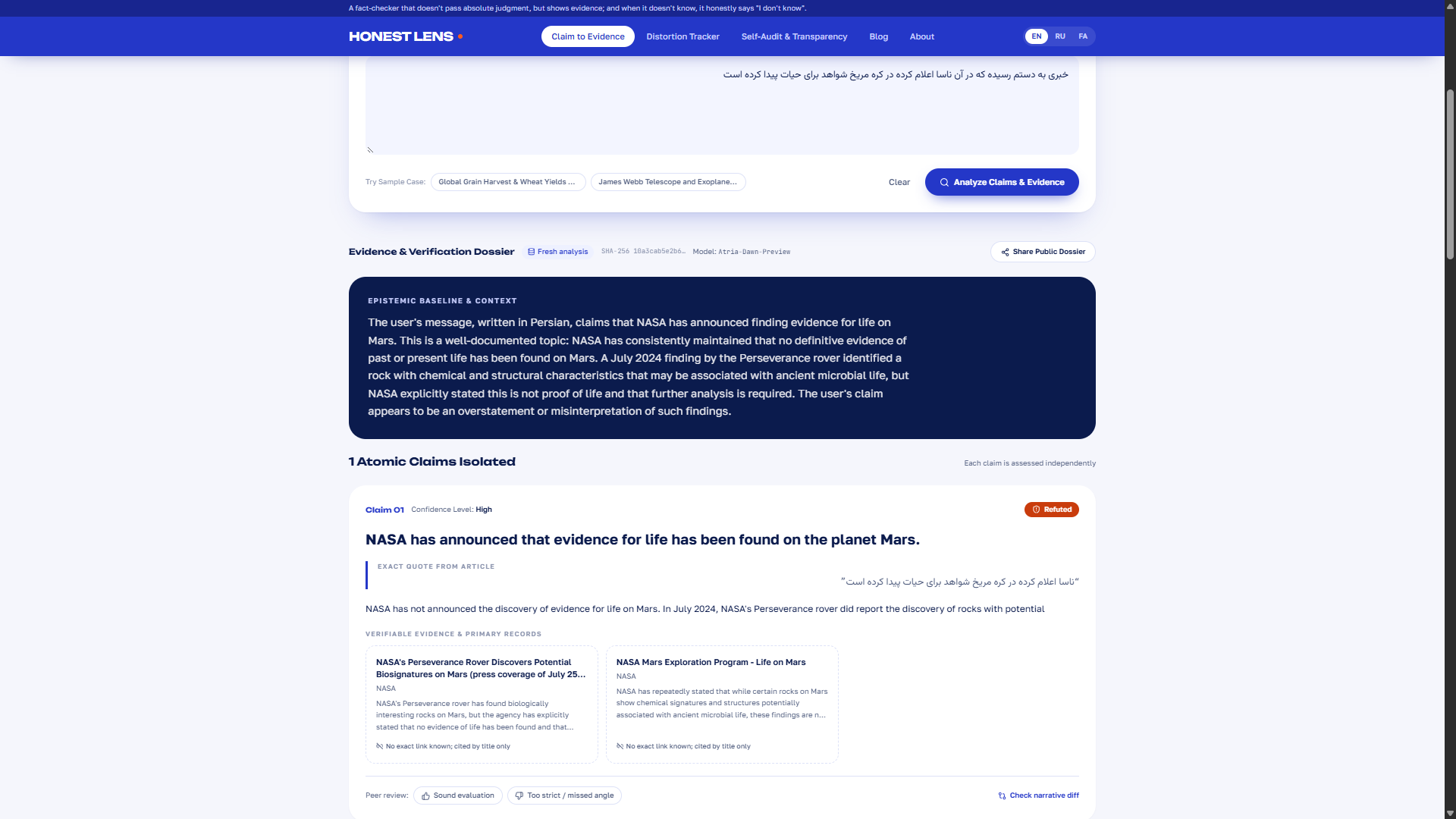
The user enters anything: a headline, a forward message, an entire article or just its link. The system reads the text, extracts measurable claims from it, and examines each claim individually. The output for each claim includes the conclusion, explanation, confidence level, and sources. This division into claims is important, because a news story is usually a mix of true, half-true, and false parts, and a blanket answer for the entire text would be misleading.
Column B: Narrative Distortion Detector
Sometimes the news is not a lie, but it is distorted: a number is enlarged, an adverb is removed or an emotional tone is added to it. Distortion Detector puts a media report next to its original source and shows exactly what's changed: added excitement, altered figures, and omitted context. This tool is useful for journalists, researchers and any careful reader who wants to see the gap between "what was said" and "what was published".
Column C: Open self-examination
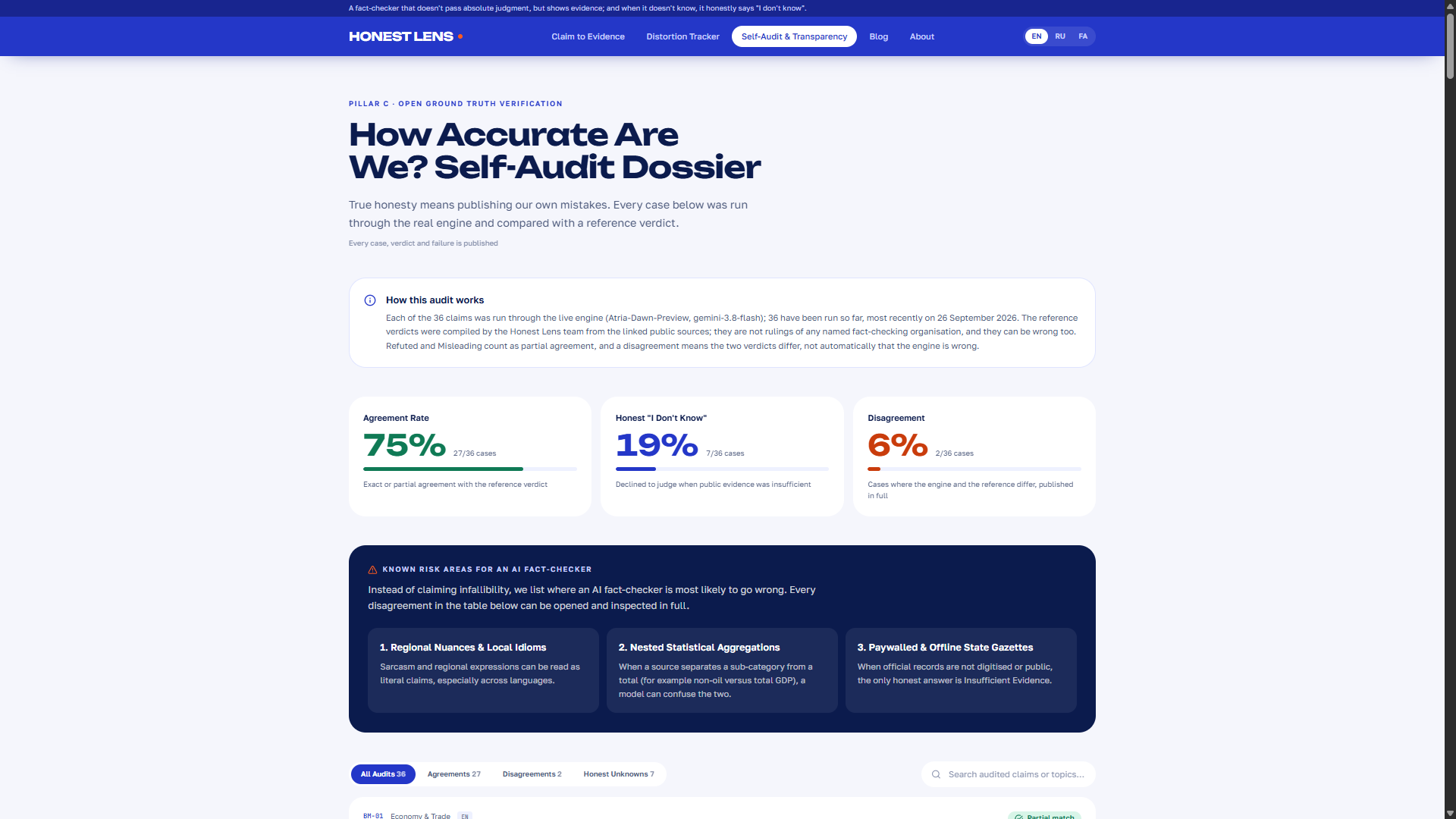
This is where Honest Lens really separates itself from similar tools. We selected a set of real claims from different domains, benchmarked each one from public sources, and then ran them all through the real engine. Results are published without manipulation, including all discrepancies. The details of this test are given below.
User Experience: From Suspicious Message to Shareable Report
We wanted the tool to be as simple as forwarding a message. The user path has three steps:
1. Enter it. A headline, a forward message, an entire article or its link. No need to register.
2. Watch the review live. Deep analysis takes some time. Instead of a blank waiting screen, the user immediately sees what the system is doing: the news text has been read, context has been sought from reference sources, claims have been weighed against the evidence, and individual links have been checked. Waiting time became part of the experience and a source of trust.
3. Get answers for every claim. Each claim has its own result, explanation and sources. Each report has a permanent link that can be sent to the same group that the news came from.
This permalink is a small but important detail. Misinformation spreads in groups and its correction should be able to spread in the same groups. Instead of a discussion, the user posts a link that shows the evidence.
Real check links
One of the things we're most proud of is that Honest Lens doesn't trust any blind links. Every link cited in the report is actually opened and reviewed. Broken or fake links will be removed and the user will be told that they have been removed. The result is that the user never encounters a resource that does not exist; A common problem with chatbot responses.
Why not just ask a chatbot?
Honest Lens also uses artificial intelligence models. The difference is in everything that is built around them. We have included this table on the main page of the site so that the user can see the value of the tool in a few seconds:
A generic chatbot may cite a source or link that doesn't exist. It will open each cited link, remove any broken links, and tell you
but Honest Lens
Even without a witness, it usually answers confidently, when there is no witness, it says "insufficient evidence."
It gives one answer for the entire text, divides the text into claims and measures each one separately
It rarely shows which sources it has actually checked, it shows which sources were used and which links were verified.
It is not known how accurate it is in the verification, it publishes its measured accuracy with all differences.
The answer will be lost in the chat history. Each report has a permanent link that you can share
Self-examination: being honest about ourselves
The easiest thing was to write "99% accuracy" on the site. Many products do the same. But a tool whose slogan is honesty cannot give a fake number about itself. So we designed a real test.
36 factual claims were selected from five areas: geopolitics, economics and business, science and health, historical documents and media sensationalism. Claims were in all three languages: Persian, Russian and English.
• For each claim, the reference result was determined based on public and citationable sources and the source link was placed next to it.
• All claims are passed through the actual engine. No results were manually written or modified.
• Result: 75% compliance with reference result, 19% honest "don't know" and 6% discrepancy.
• All 36 cases, including any discrepancies, are published on the site with a full engine report and reference source link for anyone to review.
The important point of these numbers is the 19% "I don't know" share. In these cases, instead of a wrong verdict, Motor has declared that it does not have enough evidence. This is exactly the behavior we designed. The real error, i.e. a ruling contrary to the reference's result, was only 6% and it is not hidden. We believe that the publication of errors is the most valuable document of the validity of a verification tool.
Visual design and experience
An identity that inspires "trust".
For a product about truth, the design should be calm, clear and serious, not flashy. The visual identity of Honest Lens is based on deep cobalt blue, white and a "signal" color dot, which is also seen in the logo. We reviewed several different design directions with the project owner, and a design was chosen that is both professional and journalistic, and works well in all three languages. The banner, poster and preview images of social networks were also designed in the same visual language.
Three languages, without compromise
Supporting the Persian language was not a simple translation for us. The entire interface was built from the ground up with right-to-left logic, so that when you switch languages, page layouts, icon orientation, spacing, and tables all map correctly. The numbers in each language are displayed in the format of the same language and the fonts were selected separately for Farsi, Russian and Latin readability. Each language has its own separate address, for example honestlens.ir/fa and honestlens.ir/ru, So that the user and the search engine can see each version independently.
The home page that explains the "why".
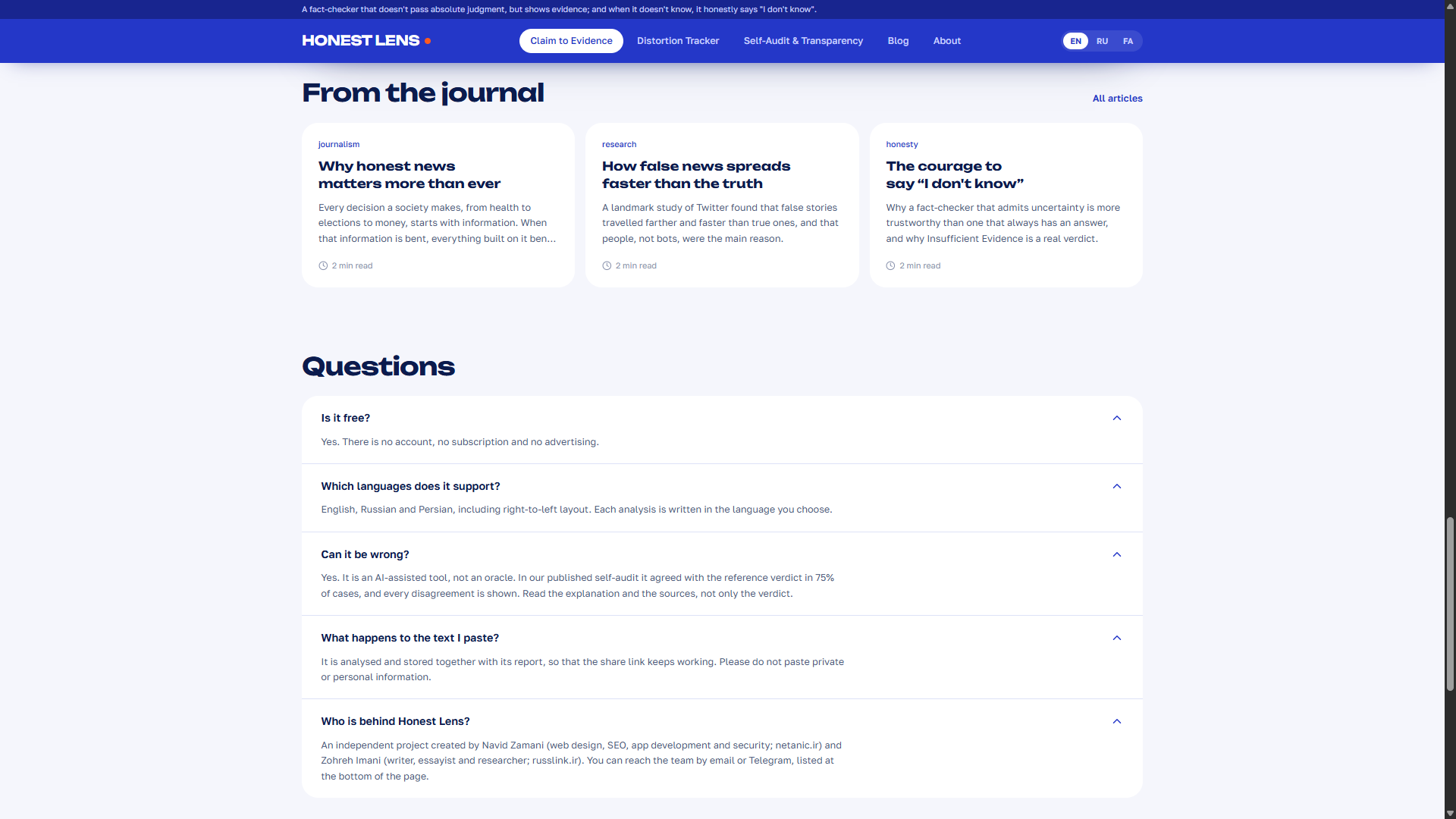
In the early versions, we noticed that the slogan of the product was not clear enough for the new user. We redesigned the home page to answer the questions in the user's mind in order: what is it, how does it work, what results does it deliver, how is it different from a chatbot, and what resources does it rely on. A scrolling bar of the sources that the engine actually cites in its reports appears on the page. We intentionally did not use media logos because we didn't want to imply an endorsement that doesn't exist. Finally, the FAQ section answers common concerns: Is it free? Could it be wrong? What happens to the text I enter?
For everyone, on any device
Most users receive news on their phones, so the design was mobile-centric from the beginning. Contrast of colors, size of buttons and keyboard navigation were also considered for accessibility.
Engineering behind the scenes
A large part of the quality of a product is in places that the user never sees. Some examples of technical decisions that have made Honest Lens reliable:
Multiple AI models, without dependence on one
Honest Lens is not affiliated with an AI provider. Several models from different providers work behind the system. If the response of the first model is late, the second model is activated in parallel and the first valid response is used. If one of the services is unavailable, the system goes to the next one without interruption. This architecture was especially important for users who live in embargoed countries and some services may be restricted for them.
Speed with smart memory, security and availability
Frequent news are usually reviewed by dozens of people. The result of each analysis is stored for some time so that if the same text is entered again, the report is displayed immediately, without waiting and without re-costing.
Security from day one
A tool that opens the desired links of users can be a way of penetration if not designed properly. We have implemented several layers of protection:
• Prevent misuse of links to access internal networks and servers. Each link is checked before opening, and at each redirection.
• Limiting the number of requests for each user, so that the tool does not become a victim of bots and indiscriminate consumption.
• Strict security headers in the browser to prevent common web attacks.
• Keeping all keys and sensitive information only on the server side, and thoroughly auditing the project to ensure that no sensitive information is in the public code.
Access to the database only from the controlled paths of the server.
• Check for software dependencies, which had no known vulnerabilities in the last audit.
Available, where the users are
The main audiences of this platform are in Iran and Russia; Places where some common internet infrastructures are slow or limited. We chose the publishing infrastructure in such a way that in the access test from Moscow, St. Petersburg, Tehran and Shiraz, the site was opened without any problems.
Visibility: SEO and optimization for AI response engines
A good tool doesn't help anyone if it can't be seen. Today, people don't just search on Google; They also ask artificial intelligence assistants. That's why Honest Lens is optimized for both search engines (SEO) and artificial intelligence (GEO):
Bot-ready content: The home page, plagiarism detector, and self-test are pre-built in all three languages, so Google bots and AI can see the entire content without running code.
Specialized blog: 20 educational articles about media literacy, verification and recognition of false information, in all three languages; A total of 60 pages of original content.
Structured data: Information about your organization, website, app, articles, and FAQs in a standard language that search engines understand.
• Linking languages: Each page refers to other versions of its language so that the user of each country can see the version of his language in the results.
• Beautiful preview in messengers: when the site link is sent in Telegram, WhatsApp or social networks, the title, description and image specific to the same page and the same language will be displayed.
• AI Special Guide: A standard file that explains to AI assistants what this site is and which pages are important.
The principles we followed in the construction
For a tool that's all about truth, the way it's made is as important as the product itself. We followed a few principles from beginning to end:
• No fake data. No stats, user reviews, or badges were faked. Every number on the site comes from actual performance.
• No unsubstantiated endorsement claims. We did not use logos of media or institutions that did not cooperate with the project.
• Transparency about limitations. In the FAQ, we have explicitly written that the tool can make mistakes and that the user should read the explanation and references, not just the result.
Respect for privacy. No registration and no ad trackers. The user is also clearly told that the text he enters will be saved to create a shared link.
Achievements at a glance
Indicator | the result |
languages | 3 complete languages (Persian, Russian, English) with native right-left |
Tools | 3 pillars: claims and evidence engine, distortion detector, self-testing |
Measured accuracy | 75% compliance, 19% honest "don't know", 6% disagreement, on 36 true claims |
transparency | 100% self-test results, including all discrepancies, have been published |
content | 60 articles (20 articles x 3 languages) |
Check the link | Every single cited link is actually opened and checked |
sustainability | Multiple artificial intelligence models with automatic replacement |
Geographical accessibility | Tested from Moscow, Saint Petersburg, Tehran and Shiraz |
security | No disclosure of sensitive information and no known vulnerabilities in dependencies |
Cost to the user | zero; No registration and no ads |
What we learned from this project
Integrity is a product attribute, not just a value. places where Honest Lens He says "I don't know" or publishes his mistakes, they are not product weaknesses; They are the main reason to trust them. In a market full of exaggerated claims, admitting one's own limitations is a competitive advantage.
Artificial intelligence is not just a product. Language models are available to everyone. The real value is in the layers that are built around them: breaking the text into claims, actually checking links, showing the process live, measuring accuracy, and designing an experience that trusts the user.
Waiting time can be turned into experience. Deep analysis takes time. Instead of hiding this time, we turned it into a window to see the system work; This transparency increased the user's trust.
True multilingualism is designed from day one. Adding Farsi to a product made for English is always incomplete. Since Honest Lens was designed trilingual from the beginning, all three versions have the same and complete experience.
summary
Honest Lens shows that it's possible to build tools with artificial intelligence that reduce rather than add to confusion; Provided that honesty, transparency and quality are observed in each product layer, from the philosophy of "I don't know" to checking each and every link, from perfect right-left design to security and visibility in search engines. We designed and implemented this project ourselves, from the idea to the publication, with all its details.
You can try it right now: a forward message or a news headline honestlens.ir Enter and see what's behind it.
Have an idea that needs to be turned into a reliable product? We are in netanic.ir We are with you from idea to publication.