Designing a smart suggestion system for sports shoes for non-natives
Infrastructure and site technical manager: Navid Zamani
Project manager and graphic designer: Sohail Motaghinia
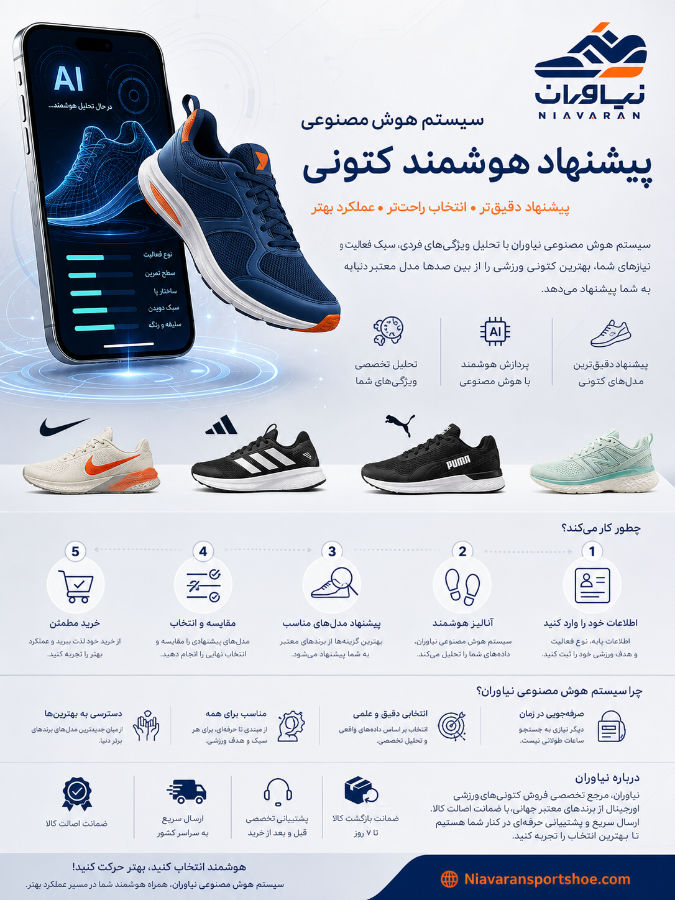
Smart suggestion system for sports shoes It was designed for the Niavaran brand with the aim of transforming the shoe selection process from a simple search to a personalized shopping experience. In the sports shoes market, the customer is usually faced with a large number of models, colors, sizes, applications and technical specifications, and he does not always know which option is the most suitable for his real needs. Niavaran's problem was not only to introduce more products, but to find a way to better understand the customer's need and turn it into an understandable and accurate offer. In this project, artificial intelligence was placed next to product data structure, user experience and sales automation Smart suggestion system for sports shoes Able to establish a relationship between product features and the real needs of each customer.
“The purpose of the sneaker smart recommendation system is not to direct the customer to a specific product; The goal is to make the customer's path to the right product shorter, more accurate and more personal.
— Netanik project manager
Smart suggestion system for sports shoes for non-users
The main issue in choosing sports shoes
Choosing sports shoes, unlike many simple purchases, depends on several variables at the same time. The type of activity, amount of use, expected form, budget, size, appearance preference and even previous customer experience can affect the final choice. In such a situation, displaying a large number of products without creating a clear decision path does not necessarily create a better shopping experience. The smart offer system for sports shoes in Niavaran was designed to solve this problem, to convert complex product information into simple and understandable offers.
The goal of system design
The goal of the project was to build a product recommendation engine that could receive customer information and compare it with structured product data. In this model, the intelligent sports shoe recommendation system does not make decisions based solely on the popularity or display order of products, but considers a set of specific criteria for each customer. Product information includes category, application, technical features, color, size, price range and other specifications that can be used in the offer engine. The final output should be understandable for the customer and, in addition to introducing the product, also explain the rationale for the offer.
The architecture of the smart recommendation system for sports shoes
Products data layer
The first step in the design of the intelligent suggestion system for sports shoes was to create a standard structure for Niavaran's product data. Each product must be converted into a set of processable features so that the smart engine can compare different models. This structure includes information such as type of use, product category, technical features, color, size, price, inventory and appearance. The more organized and accurate the product data, the more relevant the output of the intelligent sports shoe recommendation system.
Customer needs analysis layer
In the second layer, instead of focusing directly on the product, the system first analyzes the customer's needs. The customer can explain in natural language what activity they want shoes for, what features are important to them, and what price range they are considering. Artificial intelligence converts this information into processable parameters and then matches them with product features. The result of this process is creating an intelligent path to get from "need" to "suitable product".
Proposed system architecture
layer | duty | input data | output |
|---|---|---|---|
Product Data | Product information management | Shoe specifications | Structured data |
Customer Profile | Knowing preferences | Customer behavior and response | Need profile |
AI Engine | Analysis and matching | Product + need | Product proposal |
Experience Layer | Show offer | AI output | An understandable suggestion |
Analytics | Performance analysis | User behavior | System improvement data |
To design this architecture, the user's path from entering the site to receiving the product proposal was divided into several distinct stages. These steps should be implemented without creating additional complexity in the user experience and complete the information required by the system at each step.
Determining the purpose of the customer's purchase
Get the desired important features
Need analysis by smart engine
Matching needs with existing products
Generate relevant offers
Recording customer behavior to improve the system
Personalize the experience of buying sports shoes
Knowing the purpose of the purchase
One of the most important parts of the smart suggestion system for sports shoes is the detection of the purchase goal. The customer may want the shoe for everyday use, training, running, gym or a combination of different activities and this difference should be factored into the final offer. For this reason, instead of asking a lot of specialized questions, the system tries to determine the user's main need with a few simple questions. This information then becomes part of the customer's temporary profile, and the recommendation engine checks for suitable products based on that.
Understanding customer preferences
Besides the purpose of purchase, personal preferences are also very important. Some customers consider price as the main criterion, some prioritize product design and appearance, and others pay more attention to technical features or comfort. The intelligent suggestion system of sports shoes can extract these preferences from the customer's answers and his behavior on the site. In this way, a product may be the main offer for one user and a secondary option for another user.
Artificial Intelligence In choosing the right shoes
Converting natural language into processable data
One of the main capabilities of the system is the ability to receive requests in natural language. The user does not have to choose among dozens of specialized filters and can explain his needs in a simple way; For example, say "I want a light shoe for training and everyday use". AI converts this sentence into a set of processable criteria and then matches those criteria to product data. This approach makes the smart sneaker recommendation system work more like a digital advisor than a simple store filter.
Explanation of the reason for the proposal
Product recommendation is more valuable when the customer knows why a model is recommended to him. In this system, the output can provide several specific reasons for choosing it in addition to the product name; For example, fit with the application, price range or feature of interest to the customer. This explanation helps reduce ambiguity in the purchase process and makes the connection between the user's need and the product's specifications clearer. Therefore, the smart offer system of sports shoes does not only display the product, but also conveys the logic of the offer in an understandable language.
The two key features of the system are:
Analysis of customer needs with natural language
Matching needs with product features
Suggest some related options
Explanation of the reason for the proposal
Considering price and inventory
Learning from user behavior
Smart suggestion system for sports shoes and user experience
Designing the product selection path
In designing Niavaran's user experience, the goal was not to turn artificial intelligence into a complex tool on the page. A smart sneaker recommendation system should be at the point in the buying journey where the customer really needs help. For this reason, the proposed experience starts from a short interaction and receives more information from the user if needed. This structure allows the customer to reach several relevant choices without going through long forms.
Smart display of results
The results of the proposal should also be simple and comparable. Instead of displaying a large number of products, the system can display a limited set of relevant options along with the reason for the offer, important features and key product information. Such a structure helps the customer to understand the difference between the options faster and make a purchase decision with clearer information. In this section, the user interface design and the logic of the intelligent suggestion system of sports shoes should work in an integrated manner.
Product data and smart SEO Niavaran
Standard structure of product information
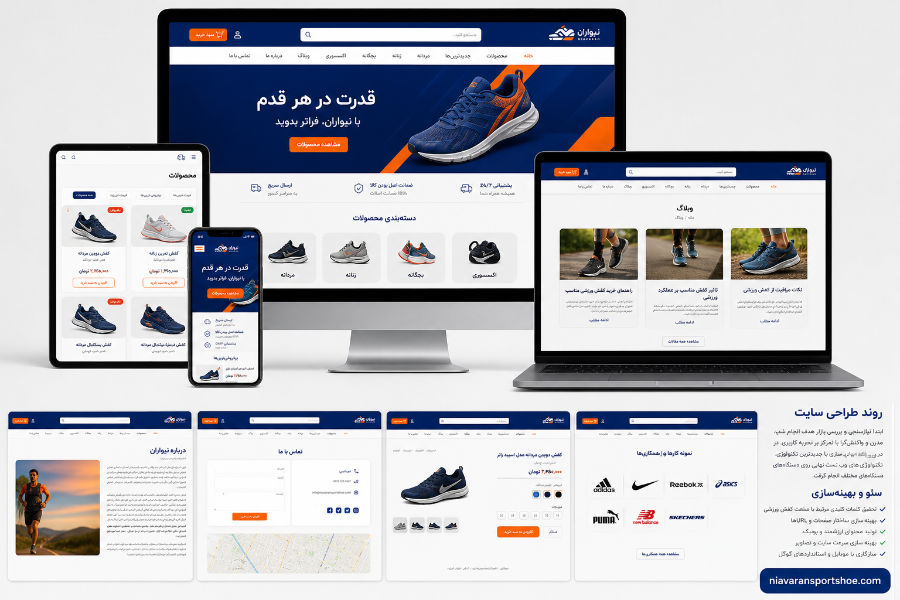
For a smart shoe recommendation system to function properly, product information must not only be visible to the user, but also structured. Information such as product name, brand, color, size, price, inventory and other related features should be managed in an orderly structure. In addition to internal use for the recommendation engine, this issue can also help search engines understand product pages better. For products such as shoes, Google has documented the use of Product and ProductGroup related structures to manage product types and attributes such as size and color.
Connecting SEO to the shopping experience
SEO in this project was not considered separately from the product experience. The product pages must be understandable for the search engine and provide the information required by the offer system to the intelligent engine. This alignment makes site content architecture, product data and user experience move in a common direction. For a specialized brand like Niavaran, this approach can also be the basis for developing a semantic search and AI-based shopping experience.
Sales automation and smart offer system
Connecting the offer to the sales process
An intelligent athletic shoe bidding system shows its true value when connected to the sales process. A product offer can sit alongside inventory, order information, user behavior and other customer touch points and become part of the sales cycle. In this structure, instead of being an independent tool, the system acts as an intelligent layer on Niavaran's digital store. This architecture also allows for the development of features such as personalized messages, offering complementary products and intelligent customer follow-up.
Customer communication automation
After the customer interacts with the system, the related data can be used to make further connections. For example, a customer who checked out a few specific models but didn't buy could receive another related offer in a permissive, satisfaction-based scenario. Likewise, customer behavior can help the sales and marketing team to understand which product categories are most popular. This connection between AI and automation makes the intelligent recommendation system of sports shoes transform from a demonstration feature to an operational infrastructure.
Analysis of customer behavior in Niavaran
Measurable indicators
To evaluate the performance of the system, the number of displayed offers alone is not a good measure. It should be checked how the users have interacted with the offers, what products they have viewed and at what stage they have left the purchase path. This data helps the Niavaran team to review and refine the quality of the smart sneaker recommendation system over time. Most importantly, data analytics should be used to improve the customer experience, not just to generate reports.
Some of the suggested indicators are:
Engagement rate with smart offers
Click rate on recommended products
The rate of adding the product to the basket
Conversion rate of users receiving the offer
Usage rate of conversational search
Customer return rate to offer experience
Continuous learning and improvement
No product recommendation system should be considered a completely static project. User behavior changes, new products enter the portfolio, and market preferences change over time. For this reason, the intelligent suggestion system of sports shoes should be able to analyze new data and modify the logic of the suggestion. In Niavaran's proposed architecture, behavioral data are considered as inputs to the system's continuous improvement cycle.
The role of AI in the future of Niavaran stores
From suggestion engine to purchase consultant
The initial version of the smart recommendation system for sports shoes can only be on Product proposal focus, but its architecture has the ability to be developed into an intelligent shopping assistant. At this stage, the customer can talk to the system about the difference between the models, the use of each shoe, the product features and choosing between several options. Such experience can bridge the gap between traditional prospecting and sales consulting. As a result, AI becomes part of the core brand experience rather than a peripheral feature.
Smart search development
The next step could be to connect the system to semantic and visual search. In the future, in addition to the textual description, the customer can use the image or the appearance sample of his interest to start the search and the system will find nearby options among Niavaran products. This path is in line with the general trend of developing AI-based shopping experiences and personalized product discovery. In its documentation and commercial products, OpenAI has also proposed product discovery and personalized shopping experience as one of the developing applications of AI.
The result of the smart suggestion system project for sports shoes
Value created for Niavaran brand
In this project, the smart suggestion system for sports shoes was not designed as an independent feature, but was considered a part of Niavaran's digital experience architecture. Combining product data, customer needs analysis, artificial intelligence, user experience and sales automation enables a more coherent path to product discovery. This structure can help Niavaran to provide an experience based on the real needs of the customer instead of just displaying the products. The expected result of the project is to create an extensible infrastructure for personalization, intelligent search and better communication with the customer, and not to claim a definitive numerical result.
Netanik's role in the project
Netanik's role in this project is to design an integrated architecture between AI, digital experience, product data and automation. In such a project, artificial intelligence alone is not the solution and creates value when the right data, the right process and the right user experience are placed on it. With a systemic view, Netanik puts different components in a single architecture so that the development of future capabilities is also possible. Niavaran's smart sports shoe suggestion system is an example of this approach; That is, using AI to solve a real business problem and not just add a technological capability.
The future of the smart recommendation system for sports shoes
Deeper personalization
The next stage of system development can move towards creating a more intelligent profile for the customer. In this model, the customer's interaction history, preferences, interest categories, and search patterns can be used within permissioned frameworks to personalize the experience. The intelligent suggestion system of sports shoes can provide more suitable suggestions to each user by combining these data. Of course, the design of this section should be done with transparency, user control and compliance with privacy requirements.
Niavaran smart ecosystem
The final vision of the project can be the creation of an intelligent ecosystem for the shopping experience of Niavaran; An ecosystem that begins with product discovery and continues until selection, purchase, after-sales service and re-interaction with the customer. In such an architecture, the smart sneaker recommendation system will be just one component of a larger platform for digital commerce intelligence. Connecting AI to product data, CRM, automation, digital content and behavioral analytics can create an infrastructure that grows as the brand grows. For Niavaran, this path means moving from a product-oriented online store to a data-oriented and intelligent shopping experience.
summary
Niavaran's smart suggestion system for sports shoes starts with a simple but important problem: how to help the customer find a product that fits his real needs among many options. The answer of this project is a combination of artificial intelligence, structured data, personalization, user experience and automation that are placed in an integrated architecture. Instead of replacing the salesperson or removing the customer's choice, this system plays the role of an intelligent layer to simplify the decision-making process. Netanik's approach in this project is to build an infrastructure that can solve the problem of product offering today and become the basis for developing a fully intelligent shopping experience in the future.